



Planetary Trail in the Moravian-Silesian Region – Visual Identity, Logo Redesign and Information System
The Planetary Trail in the Moravian-Silesian Region is an extension of the original model of the Solar System in Opava – an outdoor educational trail that translates the almost unimaginable distances of space into a scale that can be experienced within the real environment of a city and surrounding landscape. The author and main initiator of the entire project is Opava technická, an association that has been continuously developing its scientific, educational and popularization value.
I was already involved in the visual side of the project when creating the graphic design for its original Opava section. The current extension into the Moravian-Silesian Region builds on this previous work and moves the project from a local educational trail into a broader regional context between Opava and Ostrava. My goal was to preserve the continuity of the existing visual communication, unify the newly created outputs and develop a more contemporary, clearer and more memorable visual system.
The scope of the design included the redesign of the Helios logo, information panels for the Planetary Trail, a folded leaflet and the graphic design of supporting visitor materials.
Project Context
The original Planetary Trail represented a model of the Solar System at an approximate scale of 1 : 627,000,000. The individual celestial bodies are not presented merely as isolated information points, but as part of a real route that guides visitors through the city, the landscape and significant places in the region.
The new extension moves the concept beyond the Opava area towards Ostrava. Additional objects of the Solar System and its distant surroundings have been added to the model – including dwarf planets, the heliopause and the Voyager probes. As a result, the project gains a larger geographical and symbolic scale: from a local educational trail, it becomes a regional map of cosmic distances.
Helios Logo Redesign
One of the main elements of the new visual identity is the redesign of the Helios logo. The original mark was transformed into a cleaner 2D monoline form that better reflects the current character of the project and its new graphic applications.
The symbol is based on several layers of meaning. Its basic shape refers to the stand of the Planetary Trail with a miniature planet or astronomical object. At the same time, it forms the letter H, referencing the name Helios. The internal circular motif works with the idea of a gravitational centre, the curvature of orbits and the continuous movement of astronomical bodies through space under the influence of physical laws.
The logo is designed as a simple linear mark with a technical, calm and timeless character. This allows it to work both at small sizes on maps and QR navigation elements, as well as in larger applications such as panels, leaflets and digital outputs.
Visual Principle
The visual style of the project is based on the contrast of a dark space-inspired background, strong white typography, yellow navigation elements and orange-red accents. The goal was to create a system that feels technical, informative and at the same time visually attractive to the public.
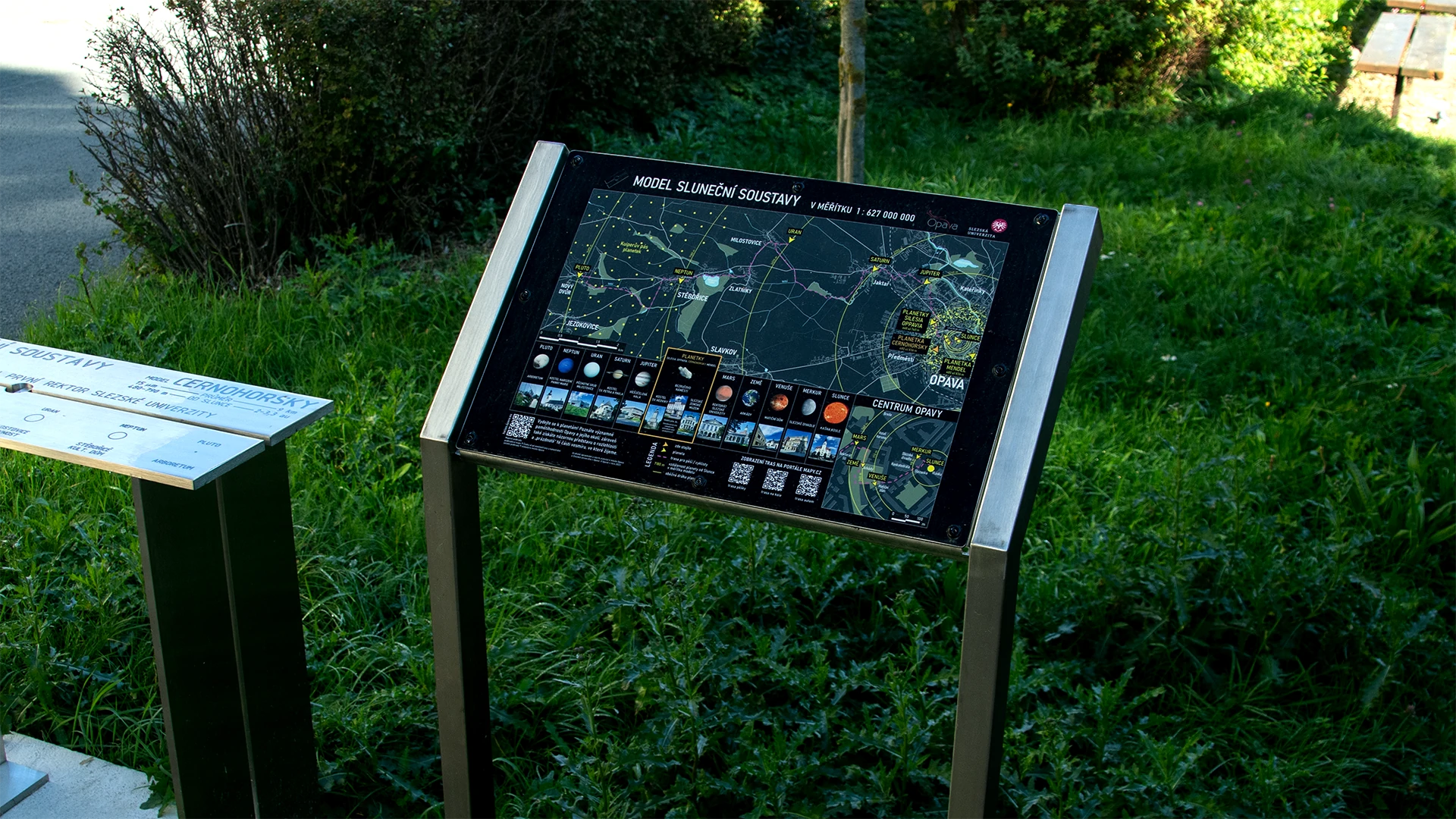
The information panels had to remain clear despite containing a large amount of data: names of celestial bodies, routes, scale, locations, photographs, QR codes, a legend and explanatory notes. For this reason, the graphic design is built on a clear hierarchy, bold labels and simple colour coding.
The resulting visual language combines astronomical accuracy with visitor-friendly usability. It is not merely decorative; it helps people understand the route, the distances and the relationship between individual objects within the entire model.
Map and Information Panel
The main output of the project is an extensive map of the Planetary Trail in the Moravian-Silesian Region. It shows both the original Opava section and the new extension towards Ostrava and other locations. The panel also includes photographs of individual stops, an overview of planets and other objects, the scale of the model, QR codes for different types of routes and a legend.
During the design process, it was important to maintain readability from a greater distance while working with a large amount of information. I therefore used bold labels, high-contrast lines, a clearly structured map section and a separate bottom strip presenting an overview of the celestial bodies. The panel functions as an orientation point, an educational material and a visually representative element of the entire trail.
Folded Leaflet
Another output was a double-sided folded leaflet. Its purpose was to translate the extensive content of the trail into a compact format that visitors could take with them. The leaflet includes a map, an explanation of the scale, an overview of objects, supporting texts, QR links and information about the routes.
The front side primarily works with the map and basic orientation within the entire model. The reverse side expands the content with more distant objects, photographs of the stops and concise information blocks. The graphic system is designed so that the leaflet remains clear even after folding, with each section retaining its own logic.
Result
The result is a unified visual communication system for the extended Planetary Trail in the Moravian-Silesian Region, connecting the original Opava model with new stops across the wider region. The redesigned Helios logo gives the project a stronger identity, while the map, panel and leaflet help visitors better understand both the route and the concept of the Solar System model itself.
The project demonstrates how graphic design can make a scientific and abstract topic more accessible to the general public. In this case, the visual system does not serve only as presentation, but also as explanation, navigation and a way to create an experience of discovering space within the real scale of the landscape.
- more information about the project on the website helios.slu.cz




Curious
what your project
could look like?
If you’re looking for a creative graphic designer who thinks in systems
and works with context, I’d be happy to discuss your project.